Start/Choosing countertops
COUNTERTOPS
Kitchen Countertops in Saugus, CA
Short answer
Quartz is bound in resin, so it will not stain and it will scorch under a pan taken straight off the burner. Granite formed under heat and pressure, so a hot pan does not affect it, but the stone is porous and has to be sealed. Porcelain is unaffected by heat and comes thin, and it is the easiest of the three to chip at a corner while it is being cut.
A slab yard is lit to sell stone, and the slab you are drawn to is standing upright with a light behind it. That is a fair way to pick a color and a poor way to pick a material. A counter in a Saugus, California kitchen lies flat, stays wet around the sink for much of the day, and regularly receives a hot cast iron pan set down without a second thought.
How the three behave once the kitchen is in use
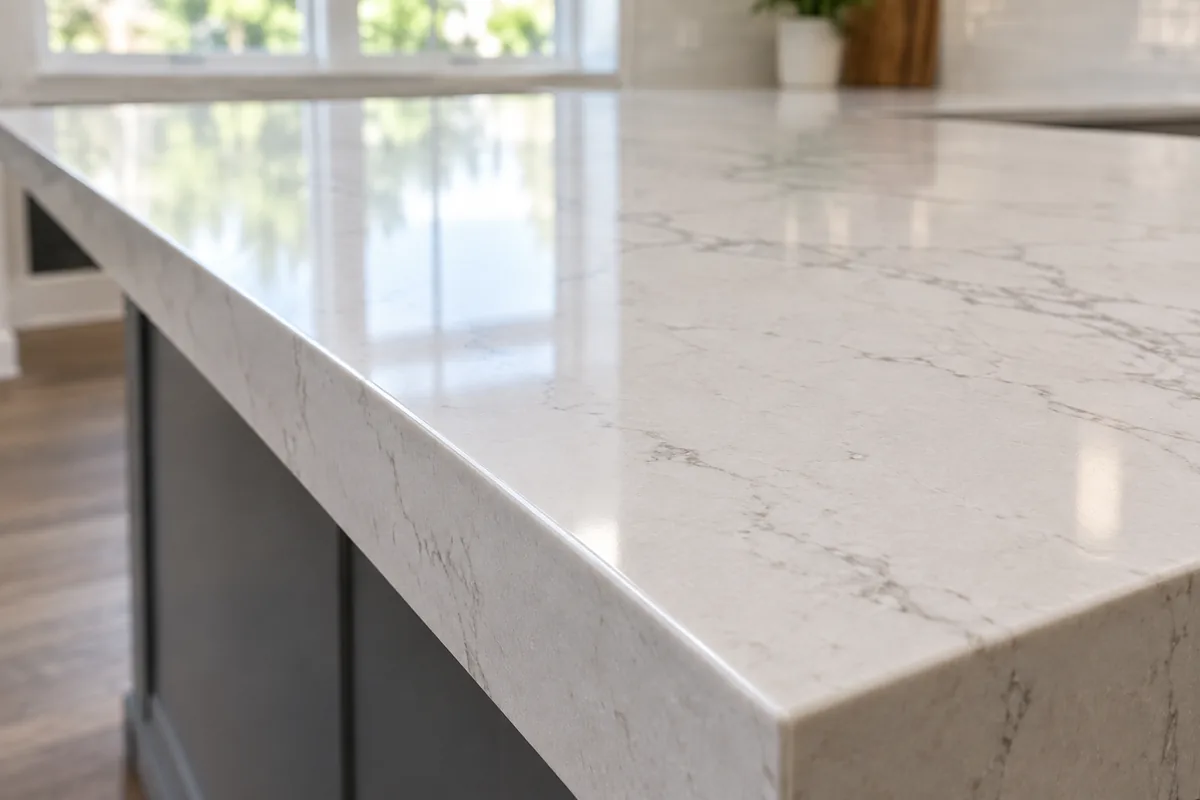 A close raking view along the polished edge of a quartz slab, the surface even and without pores.
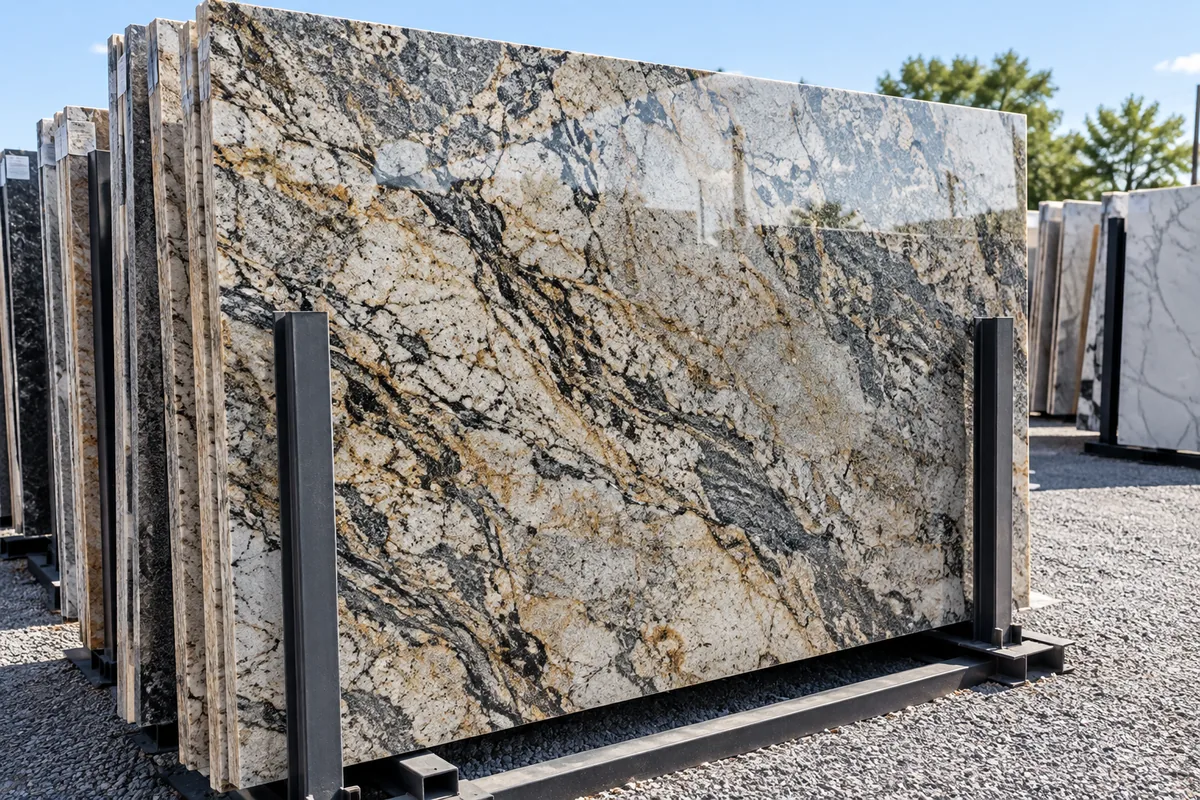 A granite slab standing on a rack in a stone yard, heavy veining running across it in daylight.
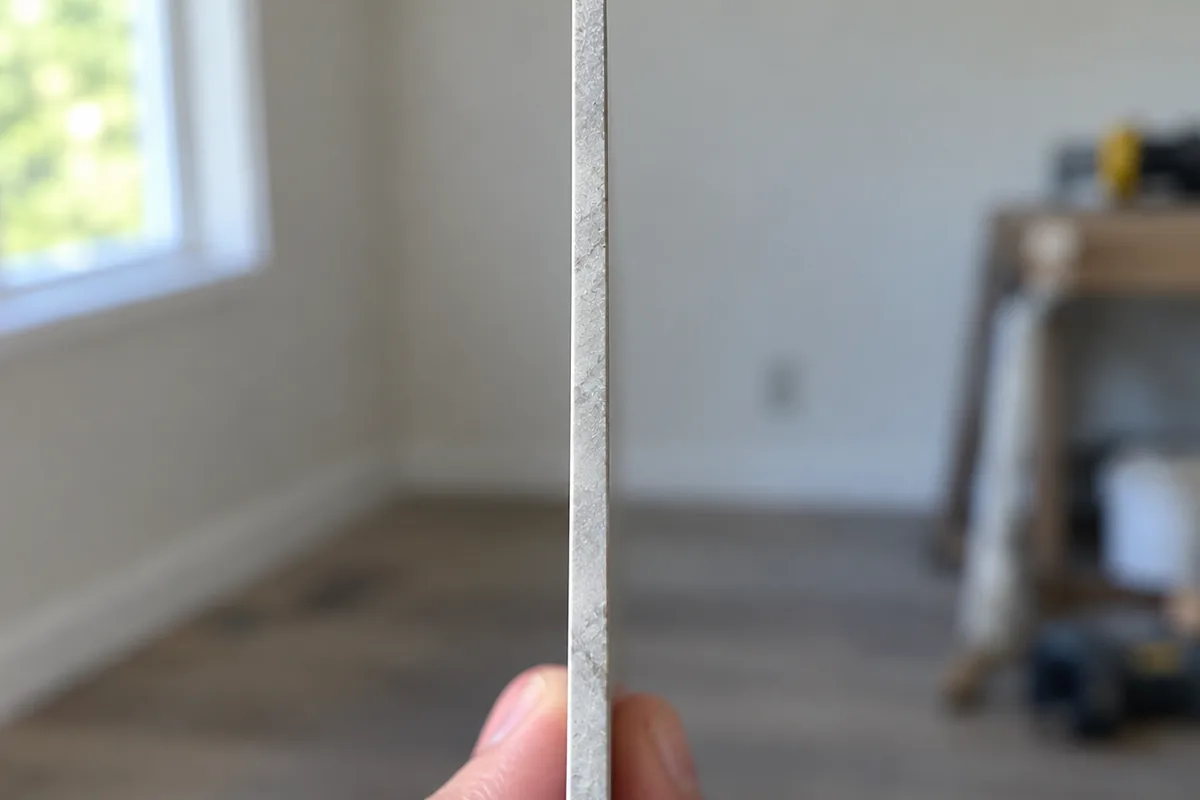 The cut edge of a thin porcelain panel held on end, showing how little thickness there is.
Quartz
Quartz is crushed stone held together with polymer resin and pigment. The resin fills every void, so there is nothing for a liquid to soak into. Lemon juice and red wine sit on the surface until you wipe them off, and there is no sealer to reapply.
That resin is also the weak point, because it is a plastic and every plastic has a temperature at which it fails. A pan lifted off a burner and set down bare can leave a dull, faintly yellow ring, and the ring does not polish out. Trivets are the remedy, which is why we ask where the hot pan will be set down while the layout is still on paper, usually a section of counter beside the range. Quartz is manufactured rather than quarried, so two slabs from the same run match, which matters the moment a long counter needs a second slab.
Ask and we will put a number against your actual room.
Ask for a priceGranite
Nothing on a domestic range approaches the temperatures that formed this stone. A hot pan does it no damage.
Porosity is the tradeoff. It varies widely between stones, since a light coarse granite absorbs water and a dense dark one barely does, so the slab gets sealed and the sealer wears off with use. You can test yours yourself. Drip water in a few spots, leave it for several minutes, and look. If the water still beads, the seal is intact. If it has darkened where each drop sat, it needs resealing, which is a wipe-on product applied in an afternoon.
Porcelain
Porcelain is a clay body fired hard, with the pattern printed on and glazed over. It does not stain, it needs no sealer, it keeps its color under sun from a south window, and it is heatproof.
The difficulty is in the fabrication shop rather than in your kitchen. Porcelain comes thin, and thin is brittle at an unsupported corner. The two risky moments are the sink cutout and the miter, where two pieces cut at forty five degrees are joined into an edge that looks like thick stone. A shop that runs porcelain every week owns the right blades and reinforces the cutout before it moves the piece. A shop attempting it for the first time learns on your slab. Ask how many porcelain tops they have made this year, then ask who pays if one cracks on the saw.
What actually moves the number on the quote
Two kitchens can choose the same slab off the same rack and arrive at very different prices. Material is a rate per square foot. Everything below is what that rate gets multiplied against, or what gets added after it.
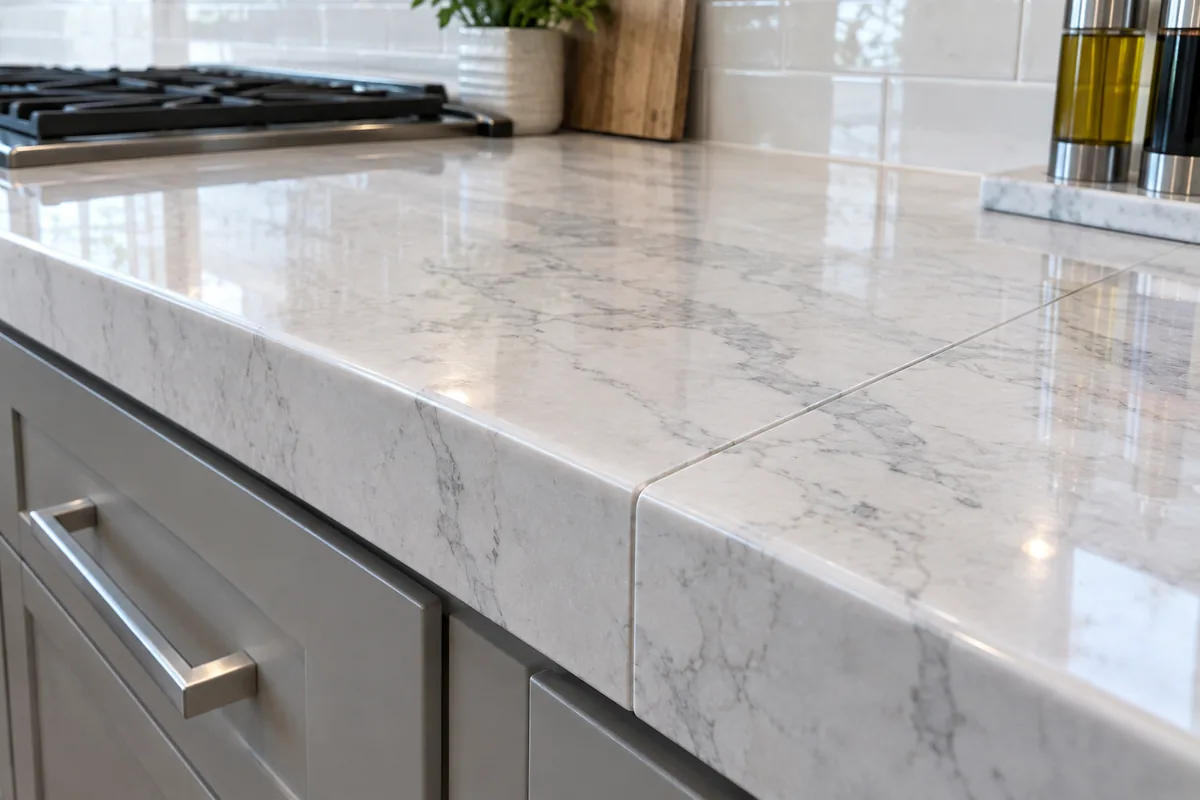 A seam where two stone tops meet on a long run, shot low and close so the joint line reads.
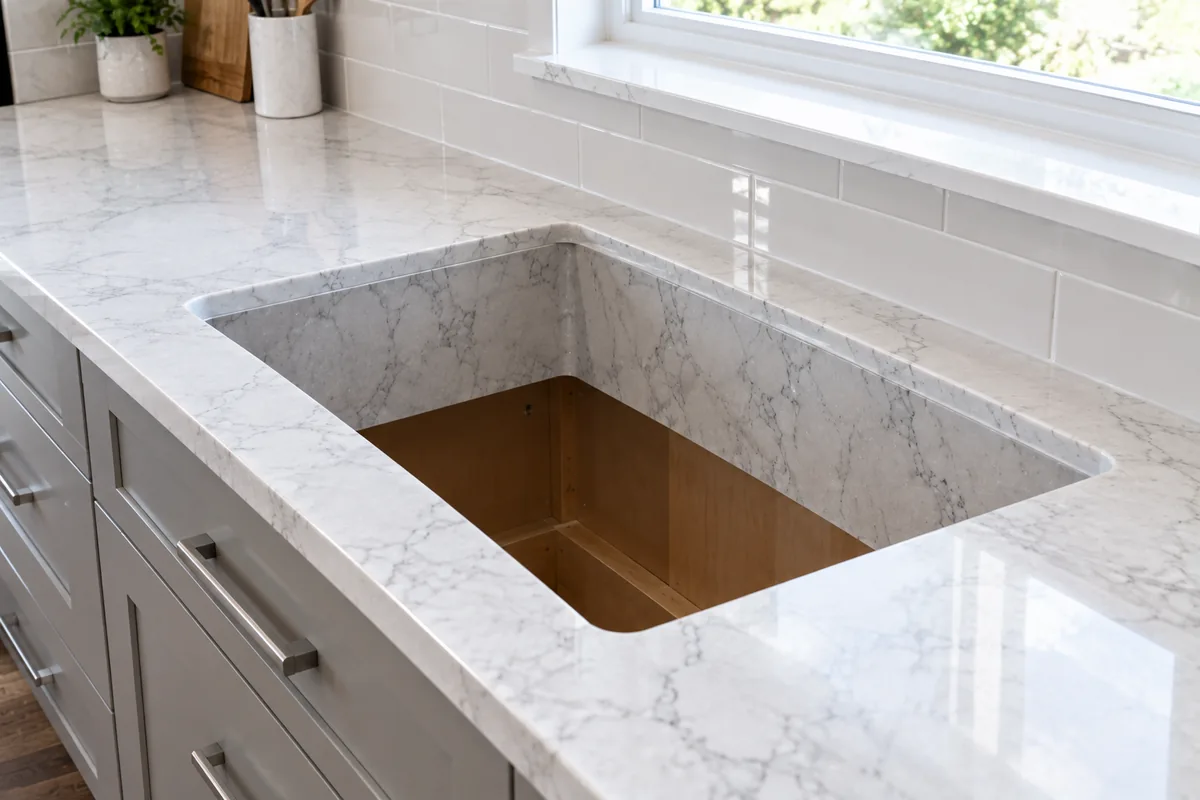 An undermount sink cutout in a stone top before the sink goes in, the polished inside edge visible.
- Slab yield
- Slabs come in finite sizes. A long run, a deep island or a full height backsplash can push you past what one slab covers, and then you buy the whole second slab, not the strip you needed out of it. The offcut is yours, and it can be kept as a windowsill or a cutting board.
- Edge profile
- An eased or pencil edge is one pass on the machine. An ogee, a stacked edge or a mitered apron is shop hours plus extra material, priced by the linear foot, so the longer your perimeter the more that one choice costs you.
- Cutouts
- Sink, cooktop, faucet, air gap, soap dispenser, and any outlet landing in a stone backsplash. An undermount sink cutout gets polished on the inside edge, because that edge is visible whenever you use the bowl, so it costs more than a drop-in concealed under a rim.
- Seams
- Where a seam lands is a decision made by the fabricator, and one you should be present for. A seam over the dishwasher opening has no cabinet under it. A seam running through a cooktop cutout leaves a short weak leg of stone at the front. Ask to see the seam layout drawn on the template before anything is cut.
- Getting the old top out
- How it went in determines how difficult removal is. A tile backsplash grouted down onto the old top, or a top glued hard to the boxes, turns a morning into a longer job and can damage the wall finish.
For scale on the whole project rather than the top on its own, the 2025 Los Angeles metro remodel numbers put a minor kitchen remodel that keeps the cabinet boxes at $29,765, returning $37,768 at resale. That is one defined 200 square foot kitchen measured across a whole metro, not a quote from us, and your counter is a fraction of it. More in what a kitchen costs.
Not sure which of these applies to your kitchen?
Ask for a priceWhy the template happens after the cabinets are set
A template is a measurement of your cabinets as they were installed, taken by the fabricator with a laser unit or a plastic pattern laid on the boxes. It cannot come off the design drawing. The drawing assumes square corners and straight walls, and no house has either. Walls bow, floors fall away toward a door, and base cabinets get shimmed to a level line rather than to the floor, so the run and the room finish as slightly different shapes. Stone cut to the drawing sits with a gap visible from the doorway.
So the order is fixed. Boxes go in, get leveled, shimmed and fastened, and only then does the fabricator template. From there the slab goes to the shop for cutting, polishing and edge work, and the maker puts that at roughly two weeks before install day. That gap is the part of the schedule people are least prepared for, because through all of it you have cabinets with no top, no kitchen sink, and a dishwasher disconnected next to it. Set up the coffee maker and the microwave elsewhere in the house before the boxes go in, not after. The full sequence is in how long a kitchen takes.
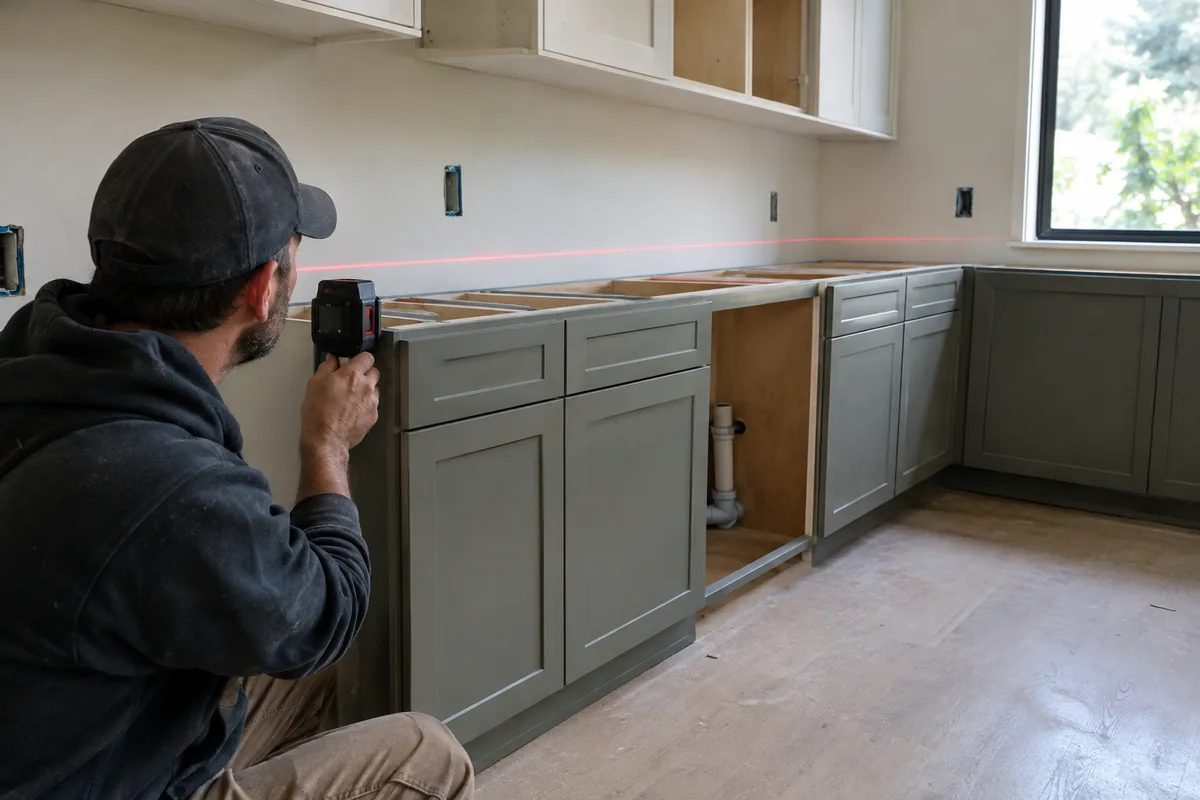 A fabricator holding a laser templating unit against an installed run of base cabinets, doors on, no countertop, sink base open, so the measurement is plainly coming off real boxes in a real room.
Why a countertop can still require a permit
Santa Clarita puts countertops on its list of work exempt from a building permit, alongside tiling and flooring. The same section then says that unless otherwise exempted, separate plumbing, electrical and mechanical permits will be required for the items it just exempted. So a top swapped on the same footprint is finish work, while moving the sink or running a circuit for a cooktop requires a trade permit. The city's Building and Safety office states that the property owner is responsible for obtaining the necessary permits before a building is altered. A low cost does not avoid that requirement, because the minor work exemption rose to $1,000 in January 2025 only for work that needs no permit of any kind, done by a person who employs nobody. More in permits and inspections.
Can I really not set a hot pan on quartz?
Do I have to buy the whole second slab?
Can I keep my cabinets and change only the top?
Bring us the slab you like and we will price the work around it
The material is the simpler half. Send us your layout and we will put numbers to the yield, the edge, the cutouts and the removal of the old top.
Ask for a priceKitchen Remodel Saugus, CA. We build kitchens in Saugus and the surrounding Santa Clarita Valley. Licensed and insured trades on every job.
Saugus, California · (661) 430-7779
How we handle your details · Site terms · Talk to us
2026 Kitchen Remodel Saugus, CA