NOTE
What goes wrong on a kitchen job, and who pays for it?
Short answer
Almost every kitchen dispute traces back to a decision made in conversation and never written down. Under a contract that sets out scope, allowances, selection dates and how a change is priced, the builder is responsible for his own errors and you are responsible for your own changes. Disputes begin when the contract is too thin to tell one from the other.
A kitchen involves a few hundred small decisions, and most of them are settled without incident. The costly ones are the few where two people understood the plan differently and no document resolved it. Six of these come up often enough on Saugus, California jobs to name in advance, along with who is responsible for the cost under a properly written contract and how each one looks before the contract is signed.
Agreements made in conversation, not in writing
A change discussed on site but not added to the drawing does not get built. You mention at the sink that the pantry door should swing the other way, the builder agrees, and the door still arrives hung the way the drawing shows it. The conversation took place; the document did not change.
The scope of work is the full extent of what is owed. Anything it leaves out is not owed at any price, so adding it later is a change order. That makes an agreement reached in conversation your responsibility to prove, which is close to impossible. Read the scope before signing and mark any sentence that could be read two ways. "Install cabinets" does not state who supplies them. Ask for the point you care about to be written in. A builder who intended to do it anyway loses nothing by putting it in writing, and his response to that request is worth noting.
An allowance set low to win the bid
An allowance is a placeholder. The quote carries a figure for tile or counters because the selection has not been made yet, which keeps the total complete. The allowance is honest when the figure is one you could realistically spend. It is misleading when it is kept low so the bottom line beats a competing quote.
The overage is yours because you agreed to the estimate, but that only holds if the estimate was plausible to begin with. Ask what the allowance actually buys at a named supplier, then examine that material in person. If the answer stays vague, the shortfall appears later as a change order, once your cabinets are on site and your leverage is gone.
We can usually tell which of these you have in an hour on site.
Ask for a price- Change order
- A price and schedule change signed by both sides before that work starts. A verbal change order is worth only what you can prove.
- Differing condition
- A condition no one could see in advance, such as a stack inside a wall. A fair contract states how these are priced, not that they never occur.
- Contingency
- Money held back for those conditions. It belongs to you, not to the quote.
Appliances picked after the cabinets were ordered
Cabinet boxes are cut to the openings around your appliances. A range narrower than the one on the drawing leaves a visible filler strip, and a panel ready refrigerator needs framing that a stainless one does not.
Responsibility here is clear. If the contract asked for your appliance cut sheets by a date and that date passed, the rework is yours. If the shop ordered boxes without asking you for model numbers, it is the builder's. Watch for a contract with no appliance deadline in it, which leaves the question open once the boxes are already built. More at keep or replace your cabinets.
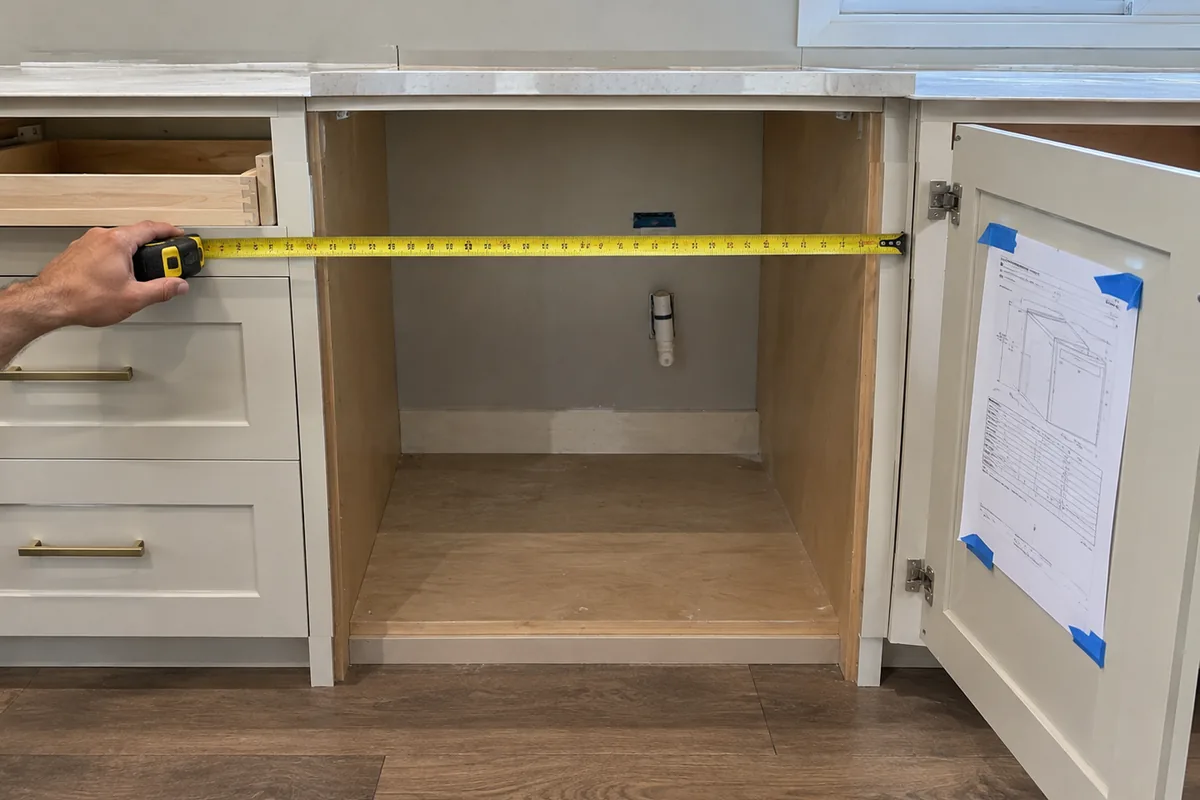 A tape measure held across a finished appliance opening between two cabinet boxes, with the appliance spec sheet taped inside the door of the next cabinet along.
If your room matches none of these, say so and we will say which way it leans.
Ask for a priceA wall that turns out to be load-bearing
No one can see inside a closed wall. It opens to reveal joists bearing on it, a vent stack, or a beam that needs a post and a footing under the slab. That is a differing condition, priced as a change order, because it is no one's error. A fair contract states this before demolition begins: the assumption is written down, along with who pays for the engineer's letter and the method for pricing the work if the assumption proves wrong. An estimate that quietly assumes the best case has saved you nothing. It has only placed the cost where you cannot see it yet. See moving walls and plumbing.
Work covered before it passed inspection
Santa Clarita exempts countertops from a building permit, along with tiling, flooring and similar interior finish work, and cabinets under eight feet in a house. The same section then states that unless otherwise exempted, separate plumbing, electrical and mechanical permits are still required for the items it just exempted. That language appears in the city's building code amendments, and its Building and Safety office places the duty to obtain the necessary permits on the property owner.
Who is responsible afterward
Tearing out and redoing failed work is the responsibility of whoever covered it. The unpermitted work itself becomes your responsibility at resale, because the record follows the property rather than the crew. California raised its minor work exemption from $500 to $1,000 in January 2025 on two conditions, that the job needs no permit of any kind and that the person doing it employs nobody, so the agency that licenses California contractors leaves no room for an unpermitted kitchen. Tie a payment draw to a passed rough inspection and there is no reason to close a wall early. See permits and inspections.
Worth asking before you commit to a scope.
Ask for a priceA lead time left off the schedule
Cabinets, slab fabrication and a panel ready refrigerator each run on their own timeline, and those timelines start when an order is placed, not when demolition begins. A four week wait for a door style is not a delay if it is on the schedule. It is a delay only when the schedule treated the wait as zero.
If the builder controls ordering and ordered late, the idle weeks are his. If a selection deadline passed while you were still choosing between two door styles, they are yours. A schedule that lists trades but no order dates is incomplete. See how long it takes.
Can we settle the extras at the end?
The builder says his contract is standard. Should that worry me?
Most of this is prevented by careful paperwork
None of these six require bad intent from anyone, and none of them get cheaper after demolition. Send us the quote you are holding, whoever wrote it, and we will mark which of these gaps it leaves open.
Ask for a priceKitchen Remodel Saugus, CA. We build kitchens in Saugus and the surrounding Santa Clarita Valley. Licensed and insured trades on every job.
Saugus, California · (661) 430-7779
How we handle your details · Site terms · Talk to us
2026 Kitchen Remodel Saugus, CA